


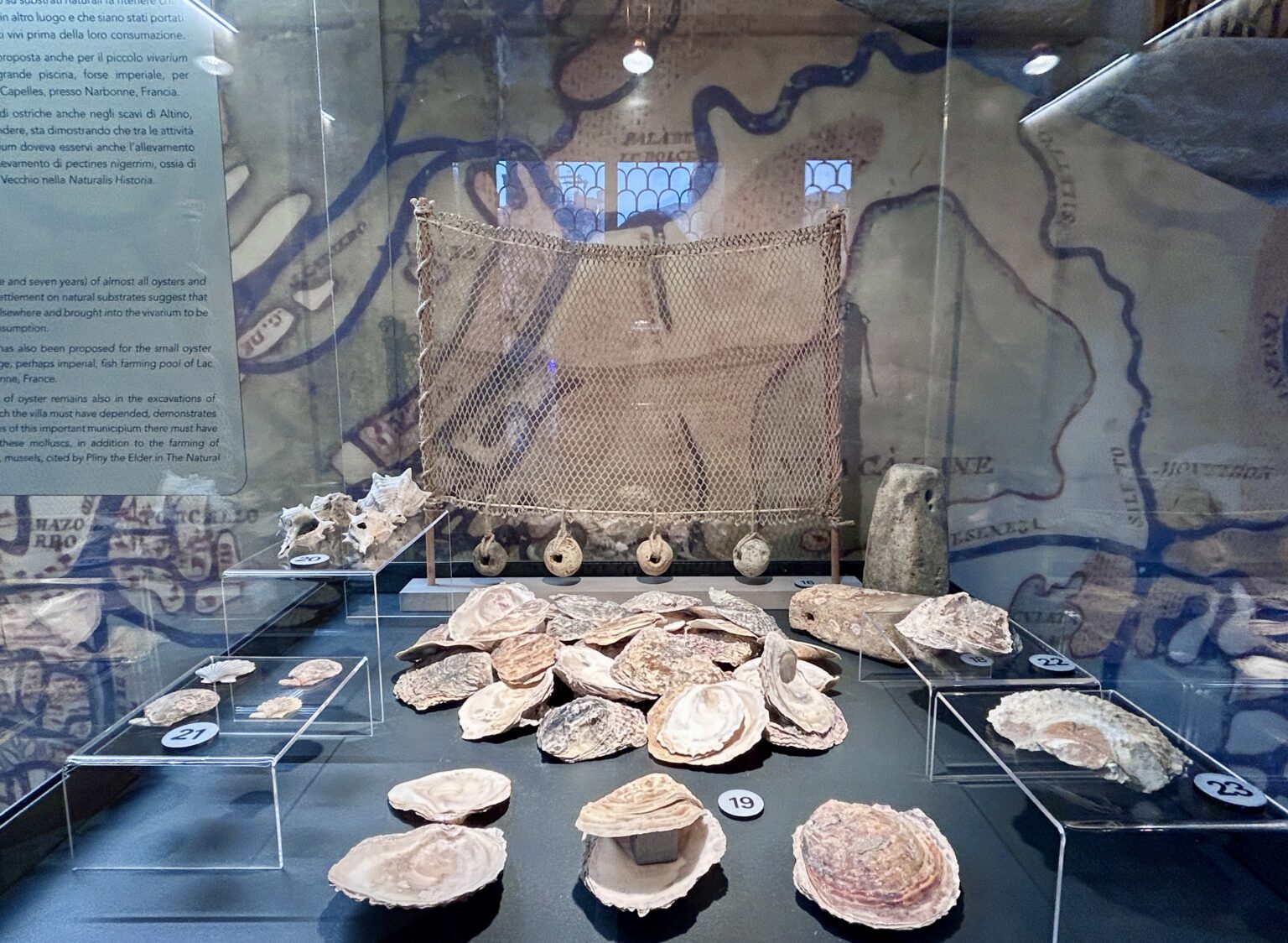

A unique discovery in Italy, destined to open up new scenarios on the history of the lagoon in Roman times has now become an exhibition inside the Natural History Museum in Venice.
It all started with research carried out by Ca’ Foscari University of Venice, which led to the discovery of a particular submerged archaeological site in the Venice lagoon, in the village of Lio Piccolo. It is here that underwater stratigraphic investigations, begun in 2021, have brought to light a brick and wooden plank tank containing around 300 oyster shells. A structure datable to the first century A.D. and interpreted as an ancient ostriarium: a space intended for keeping these molluscs alive before their consumption, most likely connected to a villa.
To date, a unique discovery in Italy, which finds only one known comparison in the lagoon of Narbonne, France.
THE DISCOVERIES ON DISPLAY
Part of these significant findings, objects, images, videos of underwater excavation operations and research activities, as well as a three-dimensional model of the lagoon archaeological site, will be on display until November 2nd at the Natural History Museum in Venice. The exhibition displays the first results of this research project, providing further information on the inhabitants of the lagoon in the Roman imperial period and, not least, highlighting the importance of interdisciplinary scientific research work that involved archaeologists, geologists and biologists.
All the Museum’s activities and initiatives can be found at: https://msn.visitmuve.it/