


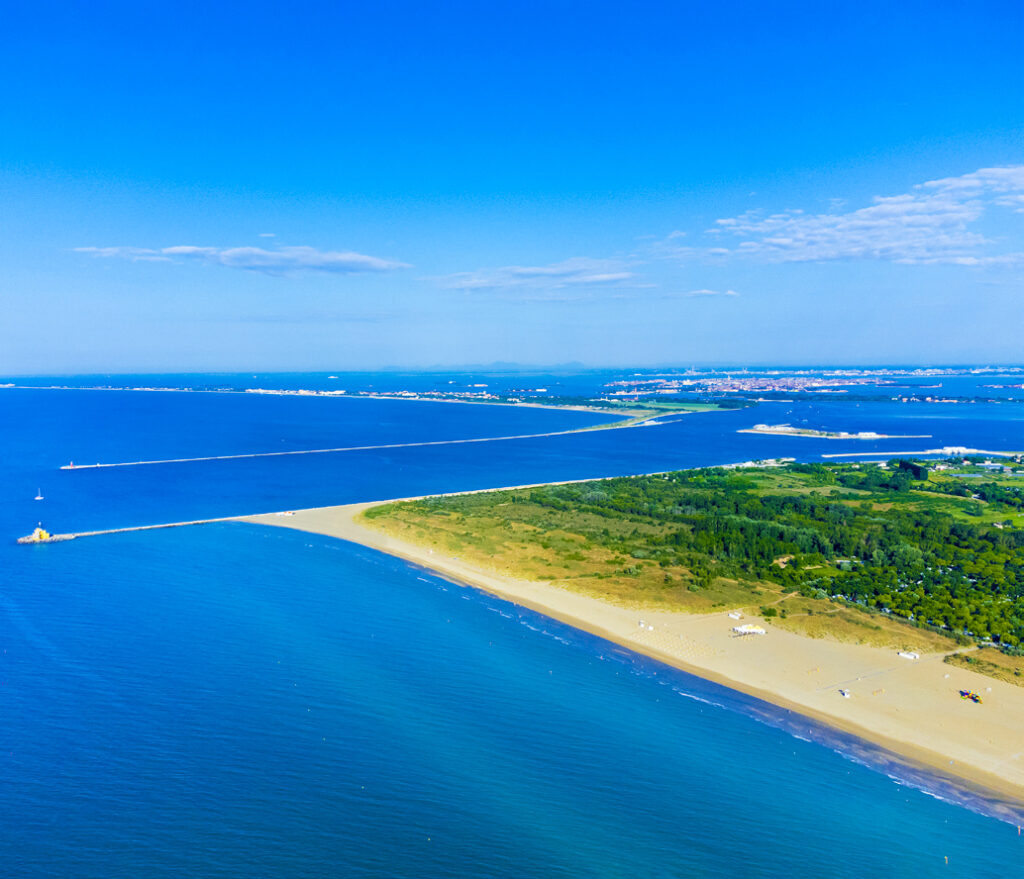

Cavallino-Treporti illustrates the ongoing relationship between land and water.
Nestled between the Northern Lagoon of Venice and the Adriatic Sea, its current landscape is the result of a long evolutionary process shaped by sediments, tides, rivers, canals and human intervention.
Over the centuries, this coastline has been transformed by the combined action of fresh and salt water. Rivers have carried sand and sediment towards the coast, whilst tides and currents have shaped salt marshes, canals, islands and landmasses. Lio Piccolo, Treporti, Cavallino and Punta Sabbioni each tell, in their own way, the story of the different stages of this transformation.
The Republic of Venice soon realised how important it was to manage the waters in order to protect the lagoon from silting up and to ensure safe navigation. To this end, rivers were diverted, canals dug and hydraulic works constructed to maintain the delicate balance between the lagoon and the sea.
This long history of the relationship between man and water is now complemented by ‘Mose’, the system of mobile barriers designed to protect Venice and the lagoon from the most severe episodes of ‘high water’. The system is situated at the three harbour mouths of Lido, Malamocco and Chioggia and allows the lagoon to be temporarily separated from the sea when tide forecasts indicate that the +110 cm threshold will be exceeded. Mose thus represents the latest chapter in a long history: that of a region that continues to seek its own balance between land, lagoon and sea.
HOW THE MOSE SYSTEM WORKS
Under normal conditions, the floodgates rest on the riverbed. When the system is activated, air is pumped into the floodgates and the barriers rise. Once the emergency is over, the floodgates fill with water again and return to the riverbed.